Buy oxg.eu ?
We are moving the project
oxg.eu .
Are you interested in purchasing the domain
oxg.eu ?
domain@kv-gmbh.de · 0541-91531010
Buy oxg.eu ?
Should it be a dry or sweet sauvignon blanc?
Whether to choose a dry or sweet sauvignon blanc depends on personal preference and the occasion. Dry sauvignon blanc is typically more crisp and refreshing, making it a great choice for pairing with seafood or salads. On the other hand, a sweet sauvignon blanc can be a good option for those who prefer a fruitier, more aromatic wine, and it can pair well with spicy dishes or desserts. Ultimately, the decision should be based on individual taste and the specific meal or setting. **
Why is Faust called Faust?
Faust is called Faust because he is the main character in Johann Wolfgang von Goethe's play "Faust." The character is based on the historical figure Johann Georg Faust, a German alchemist and astrologer who lived in the 16th century. Goethe's Faust is a complex character who makes a pact with the devil in exchange for knowledge and power, leading to a series of moral dilemmas and struggles. The name "Faust" has since become synonymous with the pursuit of knowledge and the consequences of unchecked ambition. **
Similar search terms for Faust-Cabernet-Sauvignon-2023
Top-Angebote
Products related to Faust-Cabernet-Sauvignon-2023:
-
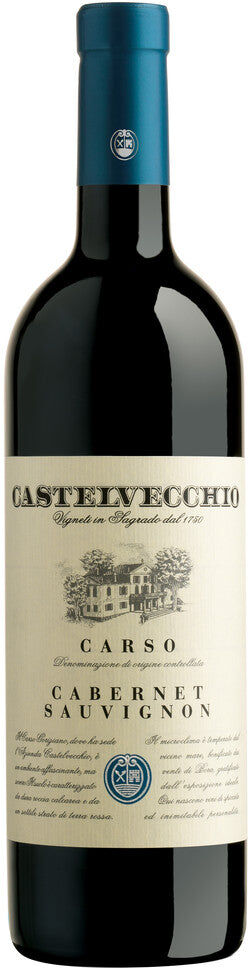
Cabernet Sauvignon Castelvecchio 2023The Cabernet Sauvignon of the Castelvecchio winery is a proud interpretation of an international grape variety that has been able to set very high standards of quality throughout the world and that here, in the Karst region, succeeds in expressing all the power and fullness of its fruit. The predominantly calcareous soil rich in minerals, aided by a climate mitigated by the Bora, a typical wind of the area, allows these grapes to develop such strength and fullness as to produce a wine with splendid ageing capabilities. The Castelvecchio 's Cabernet Sauvignon grapes are the last to be processed compared to all the other vines on the estate. Harvesting in fact begins in mid-October, so that the full ripeness of the fruit of this extraordinary vine can be exploited. Once in the cellar and fermentation has begun, the wine is placed in steel vats for approximately 4 months to complete malolactic fermentation. The Cabernet Sauvignon then spends a year in French and Californian oak barrels and a further 12 months in Slavonian oak tonneaux. The process is completed by an ageing period of 4 to 6 months in the bottle. The Cabernet Sauvignon Castelvecchio presents itself to the glass with rubicund vigour and brown hues, as if anticipating its great aromatic depth. The first breath is pampered by spicy notes of cinnamon and vanilla followed by the sweetness and elegance of cherries in spirit and raspberry. Closing the aromatic mosaic is the mineral note, a true signature of the Karst. When brought to the mouth, this Cabernet Sauvignon opens sincerely, expressing all its warmth and softness. The pleasantly thick structure almost invites chewing that betrays the great persistence of this wine. Full and karstic in its vigour, this interpretation of Cabernet Sauvignon is an excellent companion when enjoyed during a barbecue with friends or savoured on its own while awaiting the first winds of autumn.14,00 £*Shipping: 48,00 £Secure redirect to the provider
-
Cabernet Sauvignon 'N°2' Brancaia 2023The Cabernet Sauvignon "Number 2" by Brancaia is a red that well expresses the peculiar characteristics of the splendid and sunny territory of the Tuscan coast and its vocation for the cultivation of noble Bordeaux grapes. In particular, Cabernet Sauvignon produces wines of good structure, warm, enveloping, aromatically complex, and fragrant. The aging in tonneau is never invasive, and the wine retains the charm of the varietal bouquet, with aromas of red fruits, delicate spices, and hints of Mediterranean scrub. The "N2" Brancaia is born in the estate of the Tuscan Maremma, from Cabernet Sauvignon vines cultivated in parcels with sunny west and southwest exposures. The vines sink their roots into precious soils composed of silt and clay, with a strong presence of skeleton and gravel, which make them particularly draining. The warm and Mediterranean climate, mitigated by the breeze from the Tyrrhenian Sea and with significant temperature variations, gives ripe and rich grapes. The harvest usually takes place towards the end of September, and the grapes are fermented at a controlled temperature of 28°C with a maceration on the skins lasting 18 days. The wine matures in 500-liter second-pass tonneau for 12 months and completes the aging with a few months in the bottle before being put on sale. The Cabernet Sauvignon Brancaia is a red that confirms how international grape varieties, and in particular Bordeaux varieties, have found a second home in the mild and sunny climate of the Tuscan coast. Thanks to aging in already used tonneau, the wine manages to find a proper balance between the fruity notes of youth and elegant and delicate evolutionary hints, never pushed towards excessive tertiary characteristics. In the glass, it has an intense ruby red color. On the nose, it expresses the typical aromas of small dark berries, hints of underbrush, medicinal herbs, spices, and vanilla. The sip retains a lively fruity fragrance, which opens up to a good aromatic complexity, with evolved tannic structure and pleasant final freshness.20,00 £*Shipping: 48,00 £Secure redirect to the provider
-
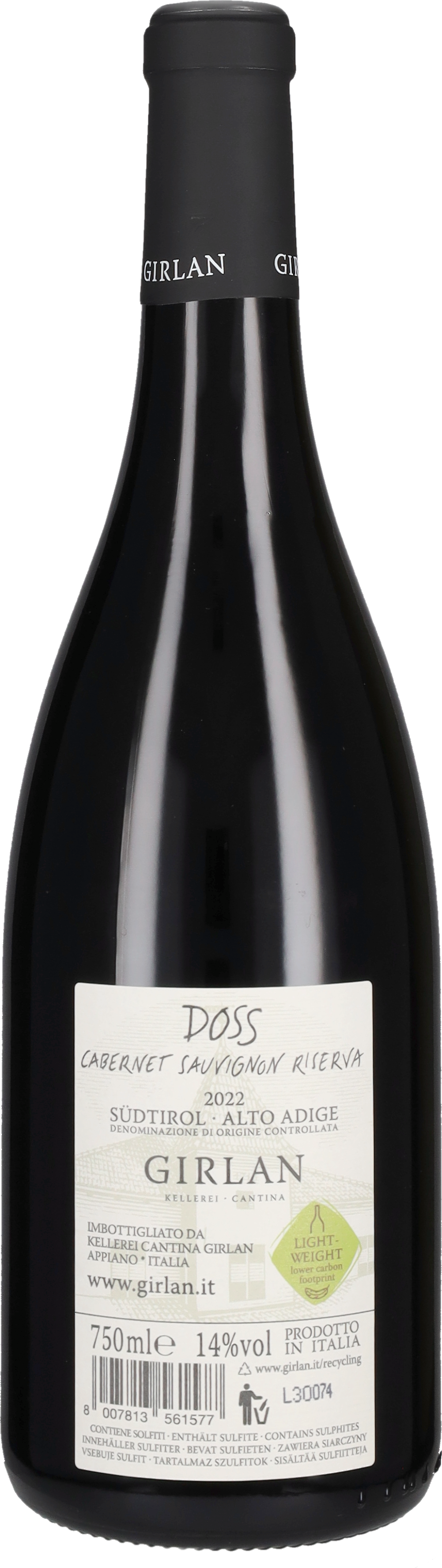
Cabernet Sauvignon Riserva 'Doss' Girlan 2023The Cabernet Sauvignon Reserve "Doss" by Girlan is born near Bolzano and the wonderful Lake Caldaro. The winery has its roots in 1923 when 23 winemakers led by Johann Kofler purchased an old farmhouse, which was then converted into a production winery. Over the years, production has steadily increased, exploiting and enhancing the potential of the Gschleir subzone, where the Pinot Noir grape can best express its intrinsic characteristics: in 2012, research related to micro-vinification led to the production of the first wine from the "Ginger" vineyard located in Mazzon. Today the winery counts more than 200 winemaker members with land holdings that reach 220 hectares in size. The vineyards of the Cabernet Sauvignon Reserve "Doss" by Girlan are located on the hills of Oltradige at an altitude between 450 and 500 meters above sea level; the soil is predominantly sandy, deep, and welcoming for the roots, fundamental components for wines with an elegant character. The climate is characterized by cold and snowy winters with temperatures often below zero and mild, sunny summers.snowy with temperatures often below zero and mild, sunny summers. The harvest is done manually and the bunches are placed in small containers for transport to the winery. After destemming, the must is fermented in steel tanks for 20 days; subsequently, malolactic fermentation occurs and aging in wood for 18 months. It rests for 6 months in the bottle. Visually, the Cabernet Sauvignon Reserve "Doss" by Girlan presents a full-bodied and impenetrable ruby red. On the nose, one can perceive hints of spice and ripe red-fleshed fruit with a balsamic and aromatic herb finish; on the palate it is elegant, inviting, and enveloping with round tannins well integrated into the drink. It pairs perfectly with grilled red meat dishes, local game; perfect with aged mountain cheeses for a wonderful end to the meal. It accompanies family celebrations and anniversaries, unleashing the authentic goodness of the Alto Adige land.16,00 £*Shipping: 48,00 £Secure redirect to the provider


-
What development does Faust undergo in Faust 2?
In "Faust 2," Faust undergoes a significant development in his character as he transitions from a restless seeker of knowledge to a more reflective and repentant figure. He grapples with the consequences of his actions and seeks redemption for his past sins. Through his interactions with characters like Gretchen and Helen of Troy, Faust gains a deeper understanding of love, morality, and the human experience. Ultimately, Faust's journey in "Faust 2" can be seen as a quest for spiritual enlightenment and inner peace. **
-
How do Faust and Gretchen come together in Faust I?
Faust and Gretchen come together in Faust I through a chance encounter in a street. Faust is immediately captivated by Gretchen's beauty and innocence, and he uses his charm and wit to win her over. Despite Gretchen's initial reluctance, she eventually falls in love with Faust and they begin a passionate relationship. However, their love story takes a tragic turn as Faust's actions lead to Gretchen's downfall. **
-
What are the differences between Faust 1 and Faust 2?
"Faust Part 1" focuses on Faust's pact with Mephistopheles and his pursuit of knowledge and pleasure, while "Faust Part 2" delves into Faust's striving for power, wealth, and ultimately redemption. In Part 1, Faust's main goal is to experience life to the fullest, while in Part 2, he seeks to leave a lasting legacy and achieve transcendence. Part 1 is more focused on individual desires and struggles, while Part 2 explores broader themes of society, politics, and spirituality. Additionally, Part 2 introduces new characters and settings, expanding the scope of the story beyond Faust's personal journey. **
-
What kind of development does Faust undergo in Faust 2?
In Faust 2, Faust undergoes a complex development that involves spiritual growth, moral reflection, and a quest for knowledge and fulfillment. Initially driven by a desire for power and worldly pleasures, Faust's character evolves as he grapples with ethical dilemmas and seeks redemption. Through his interactions with characters like Mephistopheles, Gretchen, and Helen of Troy, Faust experiences a transformation that ultimately leads to his reconciliation with God and a sense of inner peace. This development highlights themes of human ambition, the pursuit of wisdom, and the consequences of one's actions. **


Is it worth reading Goethe's Faust I and Faust II?
Yes, it is definitely worth reading Goethe's Faust I and Faust II. These two plays are considered some of the greatest works in German literature and have had a significant influence on Western literature and culture. They explore profound philosophical and existential themes, such as the pursuit of knowledge, the nature of good and evil, and the human condition. The characters are complex and the language is rich and poetic, making it a rewarding and thought-provoking read for anyone interested in classic literature. **
Who won the bet between Faust and Mephisto in Faust 1?
In Faust 1, Mephisto wins the bet with Faust. The terms of the bet were that Mephisto would grant Faust all his desires and pleasures, but if Faust ever experienced a moment of complete contentment and wished for time to stand still, he would die. Ultimately, Faust does experience a moment of contentment and wishes for it to last forever, leading to his downfall and fulfilling Mephisto's victory in the bet. **
Top-Angebote
Products related to Faust-Cabernet-Sauvignon-2023:
-
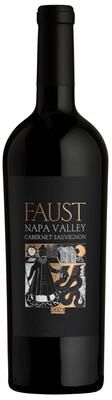
"""Faust Cabernet Sauvignon 2023 Red Wine - California""""""Elegantly structured and polished, Faust 2023 Napa Valley Cabernet is exquisitely balanced between freshness and richness on the palate. The cool forest notes that lift from the glass meld with oak spice, bay laurel, and fragrant underbrush while..."54,99 $*Shipping: 0,00 $Secure redirect to the provider
-
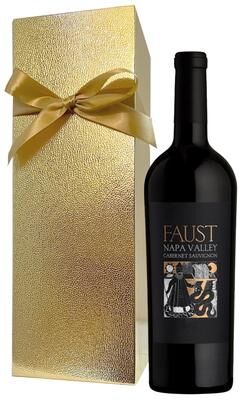
Wine.com """Faust Cabernet Sauvignon with Gold Gift Box - Other""""""Elevate your gifting game with the perfect presentation. Make an unforgettable impression by showcasing this exceptional Cabernet Sauvignon in our opulent, gleaming gold gift box. It's not just a gift; it's a statement of luxury, guaranteed to..."69,99 $*Shipping: 0,00 $Secure redirect to the provider
-
Cabernet Sauvignon Castelvecchio 2023The Cabernet Sauvignon of the Castelvecchio winery is a proud interpretation of an international grape variety that has been able to set very high standards of quality throughout the world and that here, in the Karst region, succeeds in expressing all the power and fullness of its fruit. The predominantly calcareous soil rich in minerals, aided by a climate mitigated by the Bora, a typical wind of the area, allows these grapes to develop such strength and fullness as to produce a wine with splendid ageing capabilities. The Castelvecchio 's Cabernet Sauvignon grapes are the last to be processed compared to all the other vines on the estate. Harvesting in fact begins in mid-October, so that the full ripeness of the fruit of this extraordinary vine can be exploited. Once in the cellar and fermentation has begun, the wine is placed in steel vats for approximately 4 months to complete malolactic fermentation. The Cabernet Sauvignon then spends a year in French and Californian oak barrels and a further 12 months in Slavonian oak tonneaux. The process is completed by an ageing period of 4 to 6 months in the bottle. The Cabernet Sauvignon Castelvecchio presents itself to the glass with rubicund vigour and brown hues, as if anticipating its great aromatic depth. The first breath is pampered by spicy notes of cinnamon and vanilla followed by the sweetness and elegance of cherries in spirit and raspberry. Closing the aromatic mosaic is the mineral note, a true signature of the Karst. When brought to the mouth, this Cabernet Sauvignon opens sincerely, expressing all its warmth and softness. The pleasantly thick structure almost invites chewing that betrays the great persistence of this wine. Full and karstic in its vigour, this interpretation of Cabernet Sauvignon is an excellent companion when enjoyed during a barbecue with friends or savoured on its own while awaiting the first winds of autumn.14,00 £*Shipping: 48,00 £Secure redirect to the provider
-
Should it be a dry or sweet sauvignon blanc?
Whether to choose a dry or sweet sauvignon blanc depends on personal preference and the occasion. Dry sauvignon blanc is typically more crisp and refreshing, making it a great choice for pairing with seafood or salads. On the other hand, a sweet sauvignon blanc can be a good option for those who prefer a fruitier, more aromatic wine, and it can pair well with spicy dishes or desserts. Ultimately, the decision should be based on individual taste and the specific meal or setting. **
-
Why is Faust called Faust?
Faust is called Faust because he is the main character in Johann Wolfgang von Goethe's play "Faust." The character is based on the historical figure Johann Georg Faust, a German alchemist and astrologer who lived in the 16th century. Goethe's Faust is a complex character who makes a pact with the devil in exchange for knowledge and power, leading to a series of moral dilemmas and struggles. The name "Faust" has since become synonymous with the pursuit of knowledge and the consequences of unchecked ambition. **
-
What development does Faust undergo in Faust 2?
In "Faust 2," Faust undergoes a significant development in his character as he transitions from a restless seeker of knowledge to a more reflective and repentant figure. He grapples with the consequences of his actions and seeks redemption for his past sins. Through his interactions with characters like Gretchen and Helen of Troy, Faust gains a deeper understanding of love, morality, and the human experience. Ultimately, Faust's journey in "Faust 2" can be seen as a quest for spiritual enlightenment and inner peace. **
-
How do Faust and Gretchen come together in Faust I?
Faust and Gretchen come together in Faust I through a chance encounter in a street. Faust is immediately captivated by Gretchen's beauty and innocence, and he uses his charm and wit to win her over. Despite Gretchen's initial reluctance, she eventually falls in love with Faust and they begin a passionate relationship. However, their love story takes a tragic turn as Faust's actions lead to Gretchen's downfall. **
Similar search terms for Faust-Cabernet-Sauvignon-2023
-
Cabernet Sauvignon 'N°2' Brancaia 2023The Cabernet Sauvignon "Number 2" by Brancaia is a red that well expresses the peculiar characteristics of the splendid and sunny territory of the Tuscan coast and its vocation for the cultivation of noble Bordeaux grapes. In particular, Cabernet Sauvignon produces wines of good structure, warm, enveloping, aromatically complex, and fragrant. The aging in tonneau is never invasive, and the wine retains the charm of the varietal bouquet, with aromas of red fruits, delicate spices, and hints of Mediterranean scrub. The "N2" Brancaia is born in the estate of the Tuscan Maremma, from Cabernet Sauvignon vines cultivated in parcels with sunny west and southwest exposures. The vines sink their roots into precious soils composed of silt and clay, with a strong presence of skeleton and gravel, which make them particularly draining. The warm and Mediterranean climate, mitigated by the breeze from the Tyrrhenian Sea and with significant temperature variations, gives ripe and rich grapes. The harvest usually takes place towards the end of September, and the grapes are fermented at a controlled temperature of 28°C with a maceration on the skins lasting 18 days. The wine matures in 500-liter second-pass tonneau for 12 months and completes the aging with a few months in the bottle before being put on sale. The Cabernet Sauvignon Brancaia is a red that confirms how international grape varieties, and in particular Bordeaux varieties, have found a second home in the mild and sunny climate of the Tuscan coast. Thanks to aging in already used tonneau, the wine manages to find a proper balance between the fruity notes of youth and elegant and delicate evolutionary hints, never pushed towards excessive tertiary characteristics. In the glass, it has an intense ruby red color. On the nose, it expresses the typical aromas of small dark berries, hints of underbrush, medicinal herbs, spices, and vanilla. The sip retains a lively fruity fragrance, which opens up to a good aromatic complexity, with evolved tannic structure and pleasant final freshness.20,00 £*Shipping: 48,00 £Secure redirect to the provider
-
Cabernet Sauvignon Riserva 'Doss' Girlan 2023The Cabernet Sauvignon Reserve "Doss" by Girlan is born near Bolzano and the wonderful Lake Caldaro. The winery has its roots in 1923 when 23 winemakers led by Johann Kofler purchased an old farmhouse, which was then converted into a production winery. Over the years, production has steadily increased, exploiting and enhancing the potential of the Gschleir subzone, where the Pinot Noir grape can best express its intrinsic characteristics: in 2012, research related to micro-vinification led to the production of the first wine from the "Ginger" vineyard located in Mazzon. Today the winery counts more than 200 winemaker members with land holdings that reach 220 hectares in size. The vineyards of the Cabernet Sauvignon Reserve "Doss" by Girlan are located on the hills of Oltradige at an altitude between 450 and 500 meters above sea level; the soil is predominantly sandy, deep, and welcoming for the roots, fundamental components for wines with an elegant character. The climate is characterized by cold and snowy winters with temperatures often below zero and mild, sunny summers.snowy with temperatures often below zero and mild, sunny summers. The harvest is done manually and the bunches are placed in small containers for transport to the winery. After destemming, the must is fermented in steel tanks for 20 days; subsequently, malolactic fermentation occurs and aging in wood for 18 months. It rests for 6 months in the bottle. Visually, the Cabernet Sauvignon Reserve "Doss" by Girlan presents a full-bodied and impenetrable ruby red. On the nose, one can perceive hints of spice and ripe red-fleshed fruit with a balsamic and aromatic herb finish; on the palate it is elegant, inviting, and enveloping with round tannins well integrated into the drink. It pairs perfectly with grilled red meat dishes, local game; perfect with aged mountain cheeses for a wonderful end to the meal. It accompanies family celebrations and anniversaries, unleashing the authentic goodness of the Alto Adige land.16,00 £*Shipping: 48,00 £Secure redirect to the provider
-
"""Treana Cabernet Sauvignon 2023 Red Wine - California""""""The 2023 Treana Cabernet Sauvignon opens with warm aromas of black fruits, toasted oak, leather and black tea. A lusciously textured palate unfolds with flavors of black cherry, blackberry, and a hint of fresh tobacco. The finish is sumptuous with..."28,97 $*Shipping: 0,00 $Secure redirect to the provider
-
What are the differences between Faust 1 and Faust 2?
"Faust Part 1" focuses on Faust's pact with Mephistopheles and his pursuit of knowledge and pleasure, while "Faust Part 2" delves into Faust's striving for power, wealth, and ultimately redemption. In Part 1, Faust's main goal is to experience life to the fullest, while in Part 2, he seeks to leave a lasting legacy and achieve transcendence. Part 1 is more focused on individual desires and struggles, while Part 2 explores broader themes of society, politics, and spirituality. Additionally, Part 2 introduces new characters and settings, expanding the scope of the story beyond Faust's personal journey. **
-
What kind of development does Faust undergo in Faust 2?
In Faust 2, Faust undergoes a complex development that involves spiritual growth, moral reflection, and a quest for knowledge and fulfillment. Initially driven by a desire for power and worldly pleasures, Faust's character evolves as he grapples with ethical dilemmas and seeks redemption. Through his interactions with characters like Mephistopheles, Gretchen, and Helen of Troy, Faust experiences a transformation that ultimately leads to his reconciliation with God and a sense of inner peace. This development highlights themes of human ambition, the pursuit of wisdom, and the consequences of one's actions. **
-
Is it worth reading Goethe's Faust I and Faust II?
Yes, it is definitely worth reading Goethe's Faust I and Faust II. These two plays are considered some of the greatest works in German literature and have had a significant influence on Western literature and culture. They explore profound philosophical and existential themes, such as the pursuit of knowledge, the nature of good and evil, and the human condition. The characters are complex and the language is rich and poetic, making it a rewarding and thought-provoking read for anyone interested in classic literature. **
-
Who won the bet between Faust and Mephisto in Faust 1?
In Faust 1, Mephisto wins the bet with Faust. The terms of the bet were that Mephisto would grant Faust all his desires and pleasures, but if Faust ever experienced a moment of complete contentment and wished for time to stand still, he would die. Ultimately, Faust does experience a moment of contentment and wishes for it to last forever, leading to his downfall and fulfilling Mephisto's victory in the bet. **
* All prices are inclusive of VAT and, if applicable, plus shipping costs. The offer information is based on the details provided by the respective shop and is updated through automated processes. Real-time updates do not occur, so deviations can occur in individual cases. ** Note: Parts of this content were created by AI.